Maximilian Beyer
Department of Physics and Astronomy, VU Amsterdam, Amsterdam, The Netherlands.
Molecular hydrogen is the simplest neutral molecule, yet its behavior above the ionization threshold remains a demanding test of theory. In this energy region, Rydberg states lie embedded in several continua and decay in competing ways. They autoionize to H₂⁺ + e⁻, form ion pairs H⁺ + H⁻, or dissociate into neutral atoms H(nℓ) + H(n′ℓ′). Which channel prevails depends on couplings between electronic and nuclear motion that are difficult to calculate and easy to miss in experiments that detect only one product.
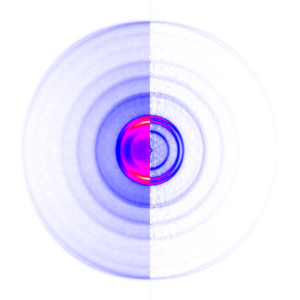
We have built a spectrometer that combines tunable vacuum-ultraviolet (VUV) laser radiation with velocity-map imaging (VMI) to follow these processes product by product. A VUV photon prepares a single rovibrational level of an intermediate electronic state. One further photon then reaches the gerade superexcited states, and two further photons reach the ungerade ones. Time-of-flight spectra show how the ion yield is shared between H₂⁺ and H⁺. Images of the H⁺ fragments give the kinetic-energy release, which identifies the dissociation limit reached, and the angular distribution, which reflects the partial waves of the departing fragments.
Multiphoton excitation does more than supply energy. Each absorption step favors particular projections of the angular momentum on the laser polarization axis, so the molecule is already aligned when the next photon arrives. I will discuss this alignment effect and its consequences for the measured angular distributions.
Part of the H⁺ signal comes not from the neutral molecule but from the photodissociation of H₂⁺ ions formed by autoionization or direct photoionization. I will explain how the photodissociation cross sections and anisotropy parameters β of this one-electron ion can be calculated from first principles.
Together, these observables provide product-resolved benchmarks for theoretical models of the coupled electron and nuclear dynamics. The same decay processes are also relevant to proposed routes for producing H̄₂⁻, the antimatter counterpart of the hydrogen molecular ion.