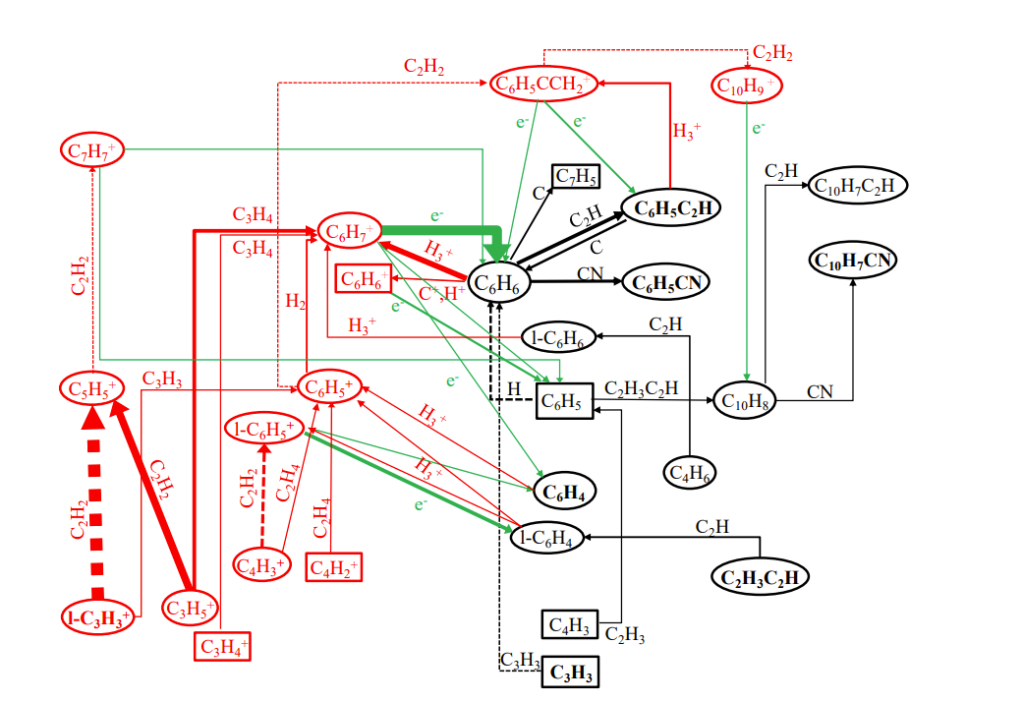
Recent work by Kocheril et al. (1) has questioned the role of phenylium (C6H5+) in interstellar aromatic chemistry. They reported that cyclic C6H5+ is unreactive toward key interstellar molecules, including H2 and C2H2, challenging its proposed role in polycyclic aromatic hydrocarbon (PAH) formation.
Here, we present experimental and theoretical evidence demonstrating that phenylium reacts efficiently with C2H2 under astrophysically relevant conditions through a barrierless mechanism. These findings reinstate phenylium as a crucial precursor in the formation of the first aromatic ring, a critical bottleneck in models of PAH growth in space.
These results are published in Nature Astronomy
Loison, JC., Rossi, C., Solem, N. et al. Evidence for phenylium reactivity under interstellar-relevant conditions. Nat Astron (2026). https://doi.org/10.1038/s41550-026-02973-9
[1] : G. Kocheril, C. Zagorec-Marks, H. Lewandowski, Nat. Astron. pp. 1–7 (2025)